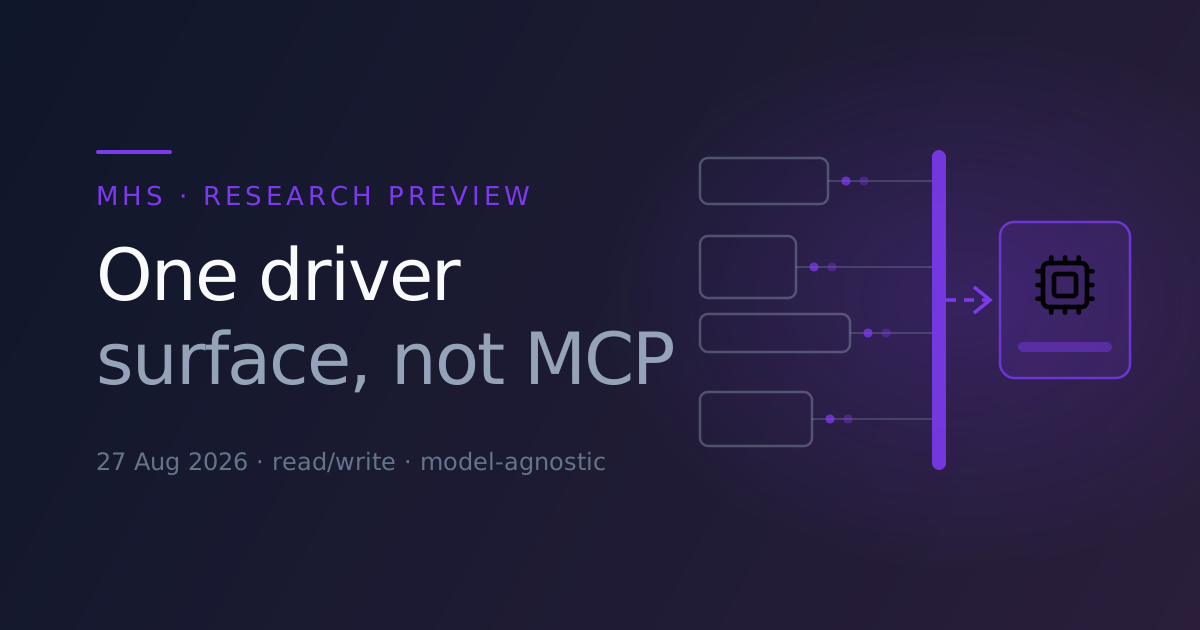
On 27 August 2026 Anthropic opened a research preview of the Model Hardware Standard, a specification that lets agents operate laboratory and manufacturing instruments. Within a day the framing had settled everywhere, including in my own first reaction: MCP, but for hardware.
That framing is wrong in a way that changes what you would do about it. The announcement is also more interesting than the framing, and considerably less available.
The relationship to MCP is not the one being reported
Several write-ups describe MHS as built on the Model Context Protocol. The announcement does not say that. It says MHS “works with any device that has a programmable interface” and that it is model-agnostic — “any agent harness can access it using standard protocols, such as the Model Context Protocol.”
Such as. MCP is one of three ways in, alongside a CLI and code file APIs. MHS sits underneath as a driver specification; it does not ride on MCP, and nothing about adopting it commits you to Anthropic’s protocol stack or Anthropic’s models.
That is not a pedantic distinction. It is the commercial design of the thing. A device manufacturer can ship an MHS driver without betting on one vendor’s agent, and an operator can drive that same driver from a shell script with no model in the loop at all. Read the vendor list — Universal Robots, Doosan, Danaher, Tecan, QIAGEN, Automata, MBF Bioscience, Raspberry Pi, AWS via Strands Robots, Hugging Face via LeRobot — and it is hard to imagine any of them signing up for something that shipped as an MCP extension.
What it actually standardises
Three things, and none of them is a protocol.
A driver architecture that reduces every device to the same primitives — read and write — so the differences between a microscope and a liquid handler stop being the integrator’s problem.
A discovery format, so that devices and agents “can find each other and communicate across networks without needing a bespoke translator program”. This is the part that kills the N-by-M integration matrix.
Natural-language tags inside the driver, where the device documents its own specifications and limits.
That third one is quiet and it is the one I would watch. Operational knowledge today lives in the heads of a small number of people and in paper manuals next to the machine. A driver that carries its own constraints in a form both a human and an agent can read is a different kind of artifact from a PDF — it is the tacit knowledge finally written down somewhere that gets loaded at runtime.
The number worth quoting
Most of the announcement is qualitative. One partner published numbers that are hard to argue with.
QuEra, on quantum laser frequency stabilisation:
| Measure | Before | After |
|---|---|---|
| Laser recovery success rate | 58% | 99.3% |
| Recovery time | 150 s | 0.9–14 s |
| Residual noise after PID tuning | 15.7 mV | 1.55 mV |
A 58% success rate is a coin flip that a human has to babysit. 99.3% is a system. That is the shape of the claim actually being made here, and it is a narrower and stronger one than “agents can now use machines”.
On integration time, the headline is that setup drops from “weeks, if not months” to “hours or minutes”. The supporting figures are more modest and more believable: Carnegie Mellon integrated three incompatible computer systems in 8 hours, and the University of Washington brought up six instruments in under a week including driver development. Days, not minutes — but against weeks, that is still the interesting number.
Two more worth keeping: Tetsuwan Scientific improved dispense-model accuracy 12–17% over the manufacturer’s own specifications, measured across 9,143 dispenses in 1,508 conditions. And at Carnegie Mellon the agent rejected its own dose-response curve at R² below 0.9 and reran with adjusted parameters to clear 0.98 — an agent noticing that its result was bad is a more useful capability than an agent producing a result.
What it is scoped to, and what it is not
The launch partners are Genentech, the Baker and Pinglay labs at the University of Washington, Carnegie Mellon, HHMI Janelia, QuEra and Tetsuwan Scientific. The hardware is microscopes, liquid handlers, plate readers, qPCR machines, robotic arms and lasers. Janelia’s case was unifying seven vendor programs across one microscopy rig.
SCADA, PLC and MES appear nowhere in the announcement. Neither does process industry, neither does plant-floor control. This is scientific research and advanced manufacturing, which in this context means benches and instruments, not a continuous operation with an interlock system and a safety case.
The extrapolation to industrial control is the obvious one to make, and I think it eventually lands — a PLC is a programmable interface, which is the only qualification MHS states. But “eventually lands” is a forecast, and it is worth keeping it separate from the announcement, because the gap between a bench instrument and a plant is exactly the safety-case work Anthropic says is not finished.
Where the human stays
The safety model is more conservative than the excitement around it suggests, and the honest parts are the useful parts.
Limits are enforced in the driver, not in the prompt. One researcher’s framing: “because MHS enforces device-level safety limits, I don’t need to worry about the agent accidentally using excess laser power.” That is the right place for a limit — a constraint the model cannot talk its way past is a constraint.
Agents pause for confirmation. From the preview: “Claude often stopped to wait for human confirmation before performing an action it deemed even slightly risky.”
And the failure that Anthropic chose to publish is the one that matters most. At Genentech the agent hit bubble-related failures in liquid handling and needed human guidance — “we had to guide it towards parameters that handled the liquid more gently” — because “Claude did not yet understand the underlying physics of the failure”.
Hold that next to the QuEra numbers. The agent tuned a PID loop to a tenfold noise reduction and could not reason about why a liquid was foaming. It is very good at closing a loop over a measurable signal and it does not have physical intuition. That is a specific, testable shape of competence, and it tells you which jobs to hand it first.
You cannot use it yet
This is the part missing from most of the coverage, and it is the part that decides whether you can act on any of the above.
MHS is a closed research preview. Access is by application at modelhardwarestandard.com, which is a landing page and an application form — it does not host the specification. The standard is not open source; the announcement says Anthropic is completing “additional safety evaluations with our launch partners” ahead of making it so, with no date attached. Devices without a programmable interface are out of scope entirely.
So there is nothing to install, nothing to read at the spec level, and no way to write a driver today unless you are one of the named partners.
What I would actually do
- Stop repeating “MCP for hardware”. It is the one line everyone has taken from this, and it misdescribes both the architecture and the commercial strategy. Model-agnostic driver spec, three access paths, MCP optional.
- Quote QuEra, not the integration claim. 58% to 99.3% is evidence. “Hours or minutes” is a marketing range whose own supporting cases took eight hours and a week.
- Apply if you have a bench. The preview is where the safety evaluations are being written, and the cost of being in that conversation early is a form.
- If you run a plant, treat this as a watch item, not a roadmap item. Nothing announced covers industrial control, and the honest read of the Genentech failure is that physical intuition is the missing piece — which is precisely what a plant runs on.
- Build the intuition anyway. A mini robotic arm and an Arduino kit will not connect to MHS today. What they will do is make you fluent in the failure modes — backlash, calibration drift, the difference between a command accepted and a command executed — before the standard opens. Raspberry Pi and Hugging Face’s LeRobot are both on the vendor list, which is the strongest available signal that the hobbyist end of this is not an afterthought.
The interesting claim in this announcement is not that agents can operate machines. It is that the integration layer between a model and a machine can be a boring, model-agnostic, self-documenting driver — and that if it is, the knowledge currently trapped in a manual and a technician’s memory becomes something a system can read. Whether that holds outside a laboratory bench is the open question, and nothing shipped on 27 August answers it.