
Most mobile apps don’t fail because of bad features. They fail because of bad architecture.
After 7+ years shipping Android apps — from solo projects to team codebases that onboard new devs every quarter — I keep coming back to the same 8 patterns from the Gang of Four book. Not because they’re academic, but because they solve real, recurring problems at production scale.
This is a practical series. No theory for its own sake — just the pattern, the Android problem it solves, and the Kotlin code that makes it click.
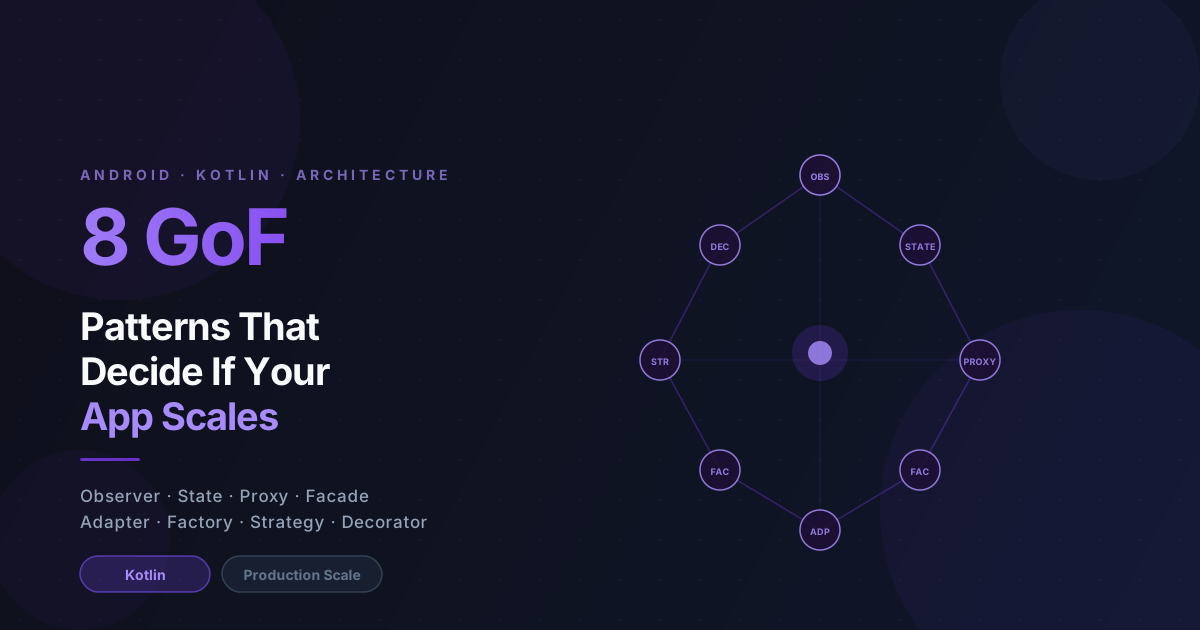
The 8 Patterns at a Glance
| Pattern | What it solves | Android context |
|---|---|---|
| Observer | UI that never goes stale | ViewModel + StateFlow |
| State | Impossible states made impossible | Sealed UiState class |
| Proxy | Cache + retry, invisible to callers | Repository layer |
| Facade | One call hides 5 use cases | Feature API for ViewModels |
| Adapter | Swap any SDK in one file | Analytics, payment SDKs |
| Factory | Mockable sources from day one | Dependency injection |
| Strategy | A/B test at runtime, zero rewrites | Feature flags |
| Decorator | Add behaviours without touching core | Logging, auth, caching |
The 4 Rules I Apply on Every Project
These aren’t guidelines — they’re constraints that prevent the most common architectural mistakes:
→ Every SDK gets an Adapter→ Repository always = Proxy (cache gate)→ One sealed UiState per screen→ Facade per feature — keep ViewModels thinBreaking any of these is fine in a prototype. In production, each one eventually costs you.
The Numbers at Scale
When these patterns are applied consistently across a codebase:
- 3× faster team onboarding — new devs find predictable structure everywhere
- 70% less boilerplate — patterns eliminate repeated decision-making
- 0 SDK lock-in with Adapter — I’ve swapped analytics SDKs in a single afternoon
- 10× faster unit tests — Factory + Adapter means no real network, no real disk
Series Structure
Each part covers two patterns — their relationship, their code, and how they interact:
- Observer & State — UI reactivity and compiler-enforced screen states
- Proxy & Facade — Cache gates and thin ViewModels
- Adapter & Factory — SDK independence and testable sources
- Strategy & Decorator — Runtime behavior and additive extensions
Architecture is the decision you make at 9am that saves your team at 2am.
Start with Part 1: Observer & State →