
Something quietly significant landed in Jetpack at the end of 2025. androidx.compose.remote — Remote Compose — is Google’s first-party answer to server-driven UI on Android. It reached alpha07 on March 25, 2026, and it’s worth understanding what it is and, more importantly, what problem it actually solves.
The Problem That Never Got Solved
Server-Driven UI (SDUI) has been a known pattern in Android for years. Airbnb, Twitter, Lyft, and others have built their own SDUI stacks. The common approach: define a JSON schema for components, ship a renderer that maps JSON keys to actual UI, and update the UI by changing the server payload.
It works. But it has real downsides:
- JSON is verbose and untyped — you build your own contract and hope both sides agree
- Renderers diverge — the client renderer and the server definition drift over time
- No compile-time safety — a typo in a component name silently renders nothing
Meanwhile, Android’s built-in solution was RemoteViews — a serializable, cross-process UI format that’s been around since Android 1.5. Glance widgets, Wear OS tiles, lock screen widgets — they all use RemoteViews today. It’s reliable but deeply limited: no custom layouts, no arbitrary composables, no Compose at all.
Remote Compose is the successor to both.
What Remote Compose Actually Is
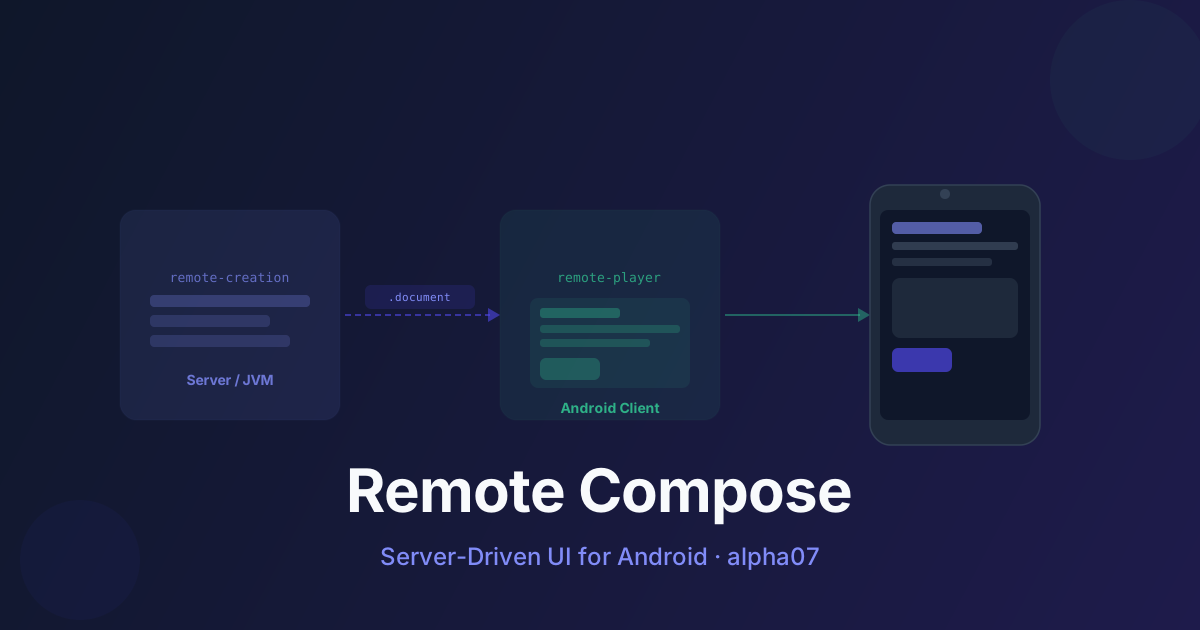
Remote Compose is a serialization layer on top of Jetpack Compose semantics. Instead of rendering to a Canvas, you write Compose-like code using the remote-creation API, and it produces a compact binary document — a serialized UI tree. That document is then transmitted (over the network, IPC, or however you want) to an Android client that renders it using the remote-player runtime.
The key insight: the client doesn’t need a Compose compiler or a Kotlin runtime for the UI code. The player just deserializes the document and paints it. No APK update required.
Server / JVM Process └── remote-creation API → writes Compose-like code ↓ produces [ binary document ] ↓ transmittedAndroid Client └── remote-player → deserializes + renders to View/Compose hostHow It Differs from JSON-based SDUI
| JSON SDUI | Remote Compose | |
|---|---|---|
| Format | Text (verbose) | Binary (compact) |
| Type safety | None (runtime) | Enforced at creation time |
| Renderer | Custom, diverges | System-provided, versioned |
| Layout power | Limited by your schema | Full Compose layout model |
| First-party | No | Yes (Google/Jetpack) |
The Glance Connection
If you’ve used Glance (the Jetpack library for widgets and Wear OS tiles), you’re using RemoteViews under the hood — the same API from 2009. Remote Compose is Glance’s future rendering backend. The migration is already in progress.
This context matters: Remote Compose isn’t an experimental curiosity. It’s the infrastructure Google is building for the next decade of widgets and cross-process UIs.
The “Back to the Future” framing that Arman Chatikyan used is apt: same problem as RemoteViews in 2009, modern solution.
Module Structure
The library is split into creation (server/JVM side) and player (Android client side):
// Server / JVM — produces documentsimplementation("androidx.compose.remote:remote-creation:1.0.0-alpha07")implementation("androidx.compose.remote:remote-creation-compose:1.0.0-alpha07") // if writing from Compose
// Android client — renders documentsimplementation("androidx.compose.remote:remote-player-core:1.0.0-alpha07")implementation("androidx.compose.remote:remote-player-view:1.0.0-alpha07")
// ToolingdebugImplementation("androidx.compose.remote:remote-tooling-preview:1.0.0-alpha07")The separation is intentional: the creation side can run on a JVM backend (a Spring service, a Cloud Function, etc.) with no Android dependency. The player side is Android-only.
The RemoteApplier Boundary
One design decision that stands out: since alpha04, the RemoteApplier is enabled by default. This is a compile-time guard that prevents regular Jetpack Compose composables from being accidentally used inside Remote Compose code.
In practice, Remote Compose functions look similar to regular Compose functions, but they’re in a different composition scope. The compiler enforces the boundary. If you try to call a regular @Composable from inside a Remote Compose function, you get a compile-time error.
This is the right call — it prevents a class of bugs where non-serializable UI leaks into a document that the player can’t render.
What’s Available in alpha07 (March 25, 2026)
The latest release added:
- Non-linear font scaling — respects accessibility settings for large text
- LayoutDirection — RTL/LTR support for international layouts
RemoteSpacer,RemoteImageVector,painterRemoteVector— newly public APIs- Semantic modifier functions — accessibility support
RemoteArrangement.spacedBy()— gap-based layout spacing- Extended
RemoteDrawScope,RemoteCanvas,RemotePainter,RemoteBrush RemoteFloatarithmetic operations andasRemoteDp()conversion
Breaking changes in alpha07:
RemoteArrangement.CenterHorizontallyremoved — useRemoteArrangement.CenterRemoteBoxalignment parameter changed to a singleRemoteAlignment
Current State: Still Alpha, But Moving Fast
The library has shipped 7 alpha releases in roughly 3.5 months (December 2025 → March 2026). The pace is aggressive: each release both adds new public APIs and breaks existing ones.
Milestone by milestone, the API surface has grown from almost nothing to a reasonably complete set of layout primitives. But the fact that every release still has breaking changes means this isn’t production-ready — yet.
Meaningful milestones so far:
- alpha04:
minSdkdropped from 26 to 23 — a signal the team intends broad adoption - alpha04:
FlowLayoutsupport added - alpha06: Java 11 target (may require desugaring)
- alpha07: Font scaling + RTL — table stakes for internationalized apps
Should You Use It Now?
For production apps: not yet. The API breaks every two weeks, and the player runtime’s capabilities are still being defined.
For Glance widget developers: start paying attention. This is where Glance is going, and early familiarity will pay off when the migration path is formalized.
For SDUI teams: worth a serious prototype. If your team has been maintaining a custom SDUI stack, the appeal of a first-party, type-safe, binary-format alternative is obvious.
For widget/tile use cases: this is arguably the most immediate practical application, since Glance is already on this path.
Next Up
In the next part, we’ll walk through a practical example: building a simple Remote Compose document on the creation side, serializing it, and rendering it inside an Android app using remote-player-view.